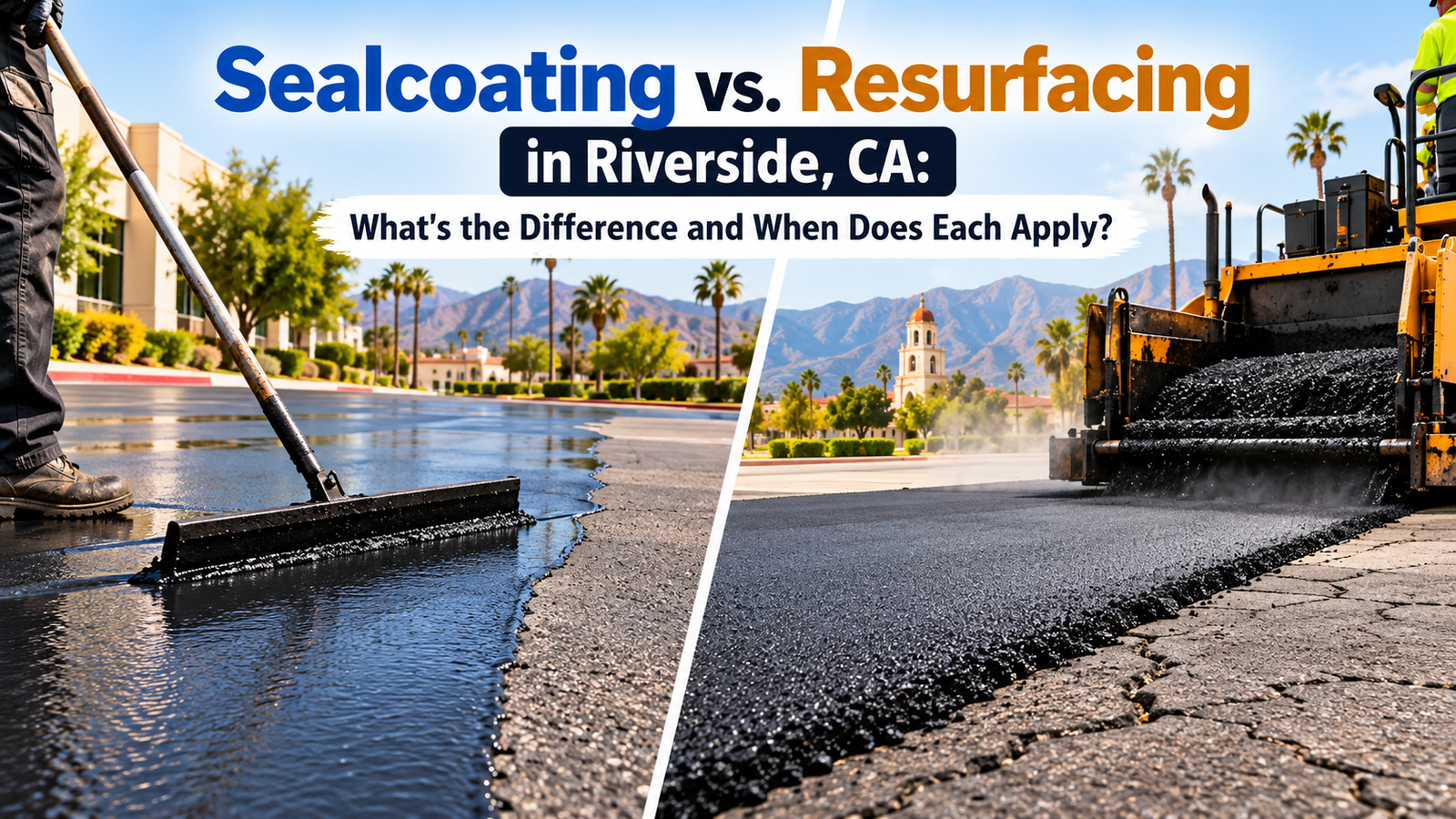
Two of the most common asphalt maintenance strategies Sealcoating vs Resurfacing Riverside are frequently confused by property owners in Riverside. They serve different purposes, address different stages of pavement deterioration, and produce very different outcomes. Understanding how each process works and when each is appropriate helps property owners in the Inland Empire make informed decisions about their asphalt surfaces.
What Sealcoating Does and Doesn’t Do
Sealcoating is a surface treatment. It applies a thin protective layer typically coal tar emulsion or asphalt emulsion over existing pavement to shield it from oxidation, UV radiation, water infiltration, and light chemical exposure. In Riverside’s climate, where summer temperatures routinely exceed 100°F and UV index values are among the highest in California, oxidation is the dominant aging mechanism for asphalt surfaces.
Sealcoating is preventive maintenance. It works best on pavement that is structurally sound no significant cracking, no base failure, no substantial rutting. The product fills small surface voids, restores a dark appearance, and slows the hardening of the underlying binder. What it does not do is repair existing damage, add structural strength, or correct drainage problems.
A sealcoat applied over cracked or deteriorated asphalt cosmetically conceals the damage without fixing it. The underlying cracks will reflect through the new coating within one to two seasons as the pavement moves under thermal cycling and traffic loads. For this reason, crack filling or sealing must precede sealcoating the sequence matters.
What Resurfacing Does
Resurfacing (also called overlaying) involves placing a new layer of hot mix asphalt over the existing pavement surface. This is a structural treatment it adds thickness, restores the surface layer, and effectively gives the pavement a new wearing course. The existing pavement serves as the base for the new layer.
Resurfacing is appropriate when the surface course has deteriorated beyond what maintenance can address extensive cracking, oxidized aggregate loss, surface roughness but the base course beneath remains structurally sound. If the base is compromised, an overlay will not hold: reflective cracking from below will appear within one to two years.
In Riverside’s climate, where intense UV radiation and thermal cycling accelerate surface aging, resurfacing typically becomes appropriate around years 10 to 15 of a pavement’s life if sealcoating and crack maintenance were performed. Lots or driveways that were never sealed may need resurfacing earlier.
The Riverside Climate Factor
Riverside sits in the Inland Empire, east of the coastal influence that moderates temperatures along the Los Angeles Basin. Summer highs regularly reach 105 to 110°F, and pavement surface temperatures can exceed 150°F on exposed lots. This intense solar loading drives asphalt oxidation and binder hardening faster than in coastal California cities.
California’s South Coast Air Quality Management District (SCAQMD) regulates the VOC content of sealcoat products used in the region. Coal tar-based sealcoats are not permitted in California due to polycyclic aromatic hydrocarbon (PAH) content and associated environmental concerns. Asphalt-based emulsion sealcoats are the compliant option in Riverside, and modern formulations provide effective protection under SCAQMD compliance.
The dry climate also means that Riverside’s pavement rarely faces the freeze-thaw damage common in colder climates, but the lack of significant winter healing means that oxidation cracks accumulate steadily rather than experiencing freeze-drive expansion and then compression-related self-closing that occurs in wetter climates.
Mill-and-Overlay vs. Simple Overlay
Resurfacing can be done as a simple overlay placing new asphalt directly on the existing surface or as a mill-and-overlay, which involves grinding (milling) the top 1.5 to 2 inches of the existing pavement before placing the new surface course.
Milling removes surface irregularities, corrects minor drainage problems by adjusting grades, and ensures the new overlay bonds to a clean surface. It also maintains clearances at curbs, drains, and doorways a concern when a surface has already received one or more overlays and additional thickness would create transition issues. Milled material (recycled asphalt pavement, or RAP) is typically recycled into new asphalt mix at the plant, making the process environmentally efficient.
Simple overlays are faster and less disruptive but cannot correct drainage issues and may create transition problems where the new asphalt meets existing curbs or structures. On properties where curb heights and drain elevations have adequate tolerance, a simple overlay is viable. On tighter sites, milling is the more appropriate approach.
Decision Framework: Which Treatment Is Right?
The condition of the existing pavement determines which treatment makes sense. Pavement that is structurally sound with oxidized surface color, minor hairline cracking, and surface void exposure is a sealcoating candidate. Pavement with moderate transverse and longitudinal cracks, surface aggregate loss, and roughness but no base failure is a resurfacing candidate. Pavement with alligator cracking, severe rutting, or settled areas is a reconstruction candidate where resurfacing would fail quickly.
A simple pavement condition index (PCI) assessment can quantify distress and guide the decision. PCI values above 70 (on a 0–100 scale) typically support sealcoating. Values between 40 and 70 support resurfacing, with structural investigation to confirm base integrity. Values below 40 generally indicate reconstruction is the appropriate response.
Frequently Asked Questions: Sealcoating vs. Resurfacing in Riverside
Can sealcoating fix cracks in my asphalt?
No. Sealcoating is a surface treatment that does not have the body to fill or bridge cracks. Cracks must be cleaned and filled with hot-applied crack sealant before sealcoating is applied. Sealcoating over open cracks simply covers them temporarily.
How long does a resurfacing treatment last in Riverside’s climate?
A properly designed and installed overlay in Riverside can last 10 to 15 years before another structural treatment is needed, assuming sealcoating and crack maintenance are performed during that period. The intense UV environment shortens the surface oxidation cycle compared to cooler climates, making ongoing sealcoating particularly important here.
How soon after resurfacing can sealcoating be applied?
New asphalt needs a minimum of 6 to 12 months to cure before sealcoating. The binder needs to off-gas lighter oils through oxidation before a sealer is applied. Sealing too early traps those volatiles, which can prevent proper curing and soften the surface.
Does resurfacing require any permits in Riverside?
Routine resurfacing of private parking lots or driveways typically does not require a permit. Work that involves grade changes, drainage modifications, or connections to public right-of-way may require review by the City of Riverside’s Public Works Department. Commercial projects may also require SWPPP compliance for stormwater if construction activity meets applicable thresholds.